


Tea Grades Explained: What BOPF, OP, FBOP Mean
Turn over a pack of Ceylon tea, and you’ll sometimes find a short string of letters sitting quietly beside the product name, description, or ingredient list. This array of characters isn't just a random combination of letters or a packaging code that should be ignored.
This is what we simply call a tea grade and is common for all teas grown worldwide. It can be referred to as a description of the leaf size. Once you understand what it actually means, you’ll be able to clear up some questions you had about the tea sitting in your cupboard.
First and foremost, here’s an important misconception worth clearing up, as it shapes everything that follows.
Broken leaf Ceylon tea is not a lesser version of whole leaf tea. It brings a whole new set of characteristics and a uniquely different cup of tea.
Grading Isn't a Quality Score, It's a Leaf Size
Every grade name on an original Ceylon-sourced tea pack describes one thing: how large the leaf pieces are once processing is finished. It has nothing to do with how good the tea is.
After the leaves are withered, rolled, and fired, they're passed through a series of sieves, largest pieces first, down to the finest particles left behind. Wherever a piece lands in that sort decides its grade. Nothing in that process ranks flavour, freshness, or quality. It simply separates leaf by size, ready to be matched to how it's most likely to be brewed.
That last part matters more than most tea packaging ever explains, and it's the key to understanding why the grade in your teapot is probably exactly right for how you drink it.
The Four Grades You'll Actually See on a UK Shelf
Tea grading has dozens of technical sub-categories used in the trade, but only four are worth knowing if you're buying tea to drink rather than to export. Here's what each one means, in plain terms.
|
Grade |
What it means |
Leaf size |
Brews |
Best suited to |
|
Whole Leaf (OP: Orange Pekoe) |
Long, twisted whole leaves, kept largely intact through processing |
Largest |
Slowly, gently |
A lighter, more delicate cup, taken plain |
|
Broken (BOP / FBOP) |
Leaves broken during rolling; FBOP includes golden tip buds for extra aroma |
Medium |
Faster, fuller |
A stronger, more rounded everyday cup |
|
Fannings (BOPF) |
Small, uniform particles sifted out after the broken grades |
Small |
Quickly, strongly |
Tea bags, and tea taken with milk |
|
Dust |
The finest particles left from sorting, not lower quality, just the smallest cut |
Finest |
Fastest, most robust |
High-speed infusions |
If you've read up on Ceylon black tea before, OP, BOP and FBOP may already look familiar; they're worth a quick recap here, but the more useful question is the one almost nothing else covers next.
Why BOPF Is the Grade Behind Most of Britain's Tea
If you've ever wondered why your everyday teabag doesn't look anything like the long, wiry leaves you'd find in a specialist tea tin, this is why, and it isn't a downgrade.
Britain's tea culture was built around a particular kind of cup: strong, quick to brew, and taken with milk. A whole-leaf grade like OP is designed to unfurl slowly and release its flavour gently, beautiful for a delicate cup taken plain, but it will never infuse fast or fully enough to stand up to a splash of milk in the few minutes most people actually give a cup of tea.
BOPF solves exactly that problem. Its smaller, broken particles expose far more surface area to the water, so it infuses quickly and fully; precisely what a proper British cup needs. It isn't the grade tea companies default to because it's cheaper or easier. It's the grade British tea-drinking habits effectively demanded, long before anyone wrote a formal definition for it.
So the next time BOPF turns up on a pack, it's worth reading for what it actually is: a leaf grade built on purpose, for a specific cup, not a consolation prize for missing out on the whole leaf.
How to Spot the Grade on Your Own Tea
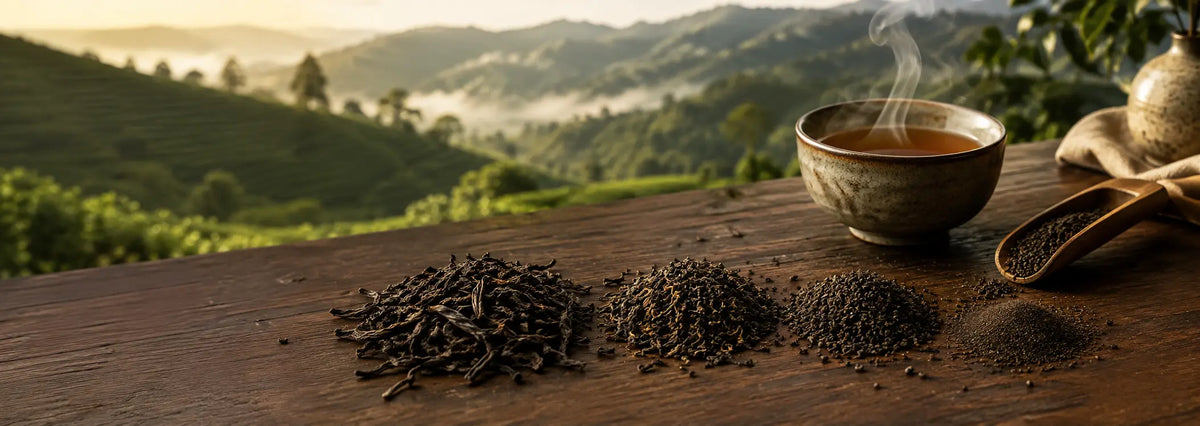
Not every UK tea brand states the grade on its packaging; many don't disclose it at all. If it isn't listed, the leaf itself is a reasonable clue: long, twisted pieces point to a whole leaf grade; small, uniform granules point to BOPF or a broken grade. Neither is "better" tea on its own, just tea suited to a different pace of brewing.
Common Questions About Ceylon Tea Grades
Is a higher tea grade always better tasting?
No. Grade describes leaf size and brewing speed, not flavour quality. A whole leaf OP and a fannings-grade BOPF can both be excellent tea; they're simply built for different brewing styles and different cups.
Does tea grade affect caffeine content?
Slightly. Smaller grades like BOPF and Dust tend to release caffeine a little faster, thanks to their larger surface area, but the difference is modest, closer to a brewing-speed effect than a meaningful caffeine gap.
What grade is best for tea with milk?
Broken or fannings grades- BOP, FBOP, or BOPF- are generally the better match. Their faster, fuller infusion holds its own against milk, which is exactly why they're the grades most common in British tea bags.
Explore Ceyara's Ceylon Black Tea · Ceyara's Ceylon White Tea

Written by Ceyara Ltd



Leave a comment
This site is protected by hCaptcha and the hCaptcha Privacy Policy and Terms of Service apply.